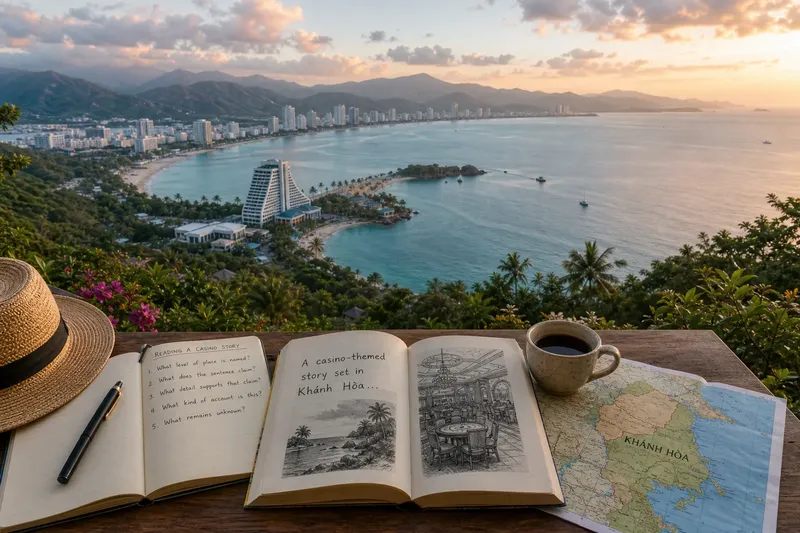
Casino Culture in Khánh Hòa Through the Historical Record
Casino culture in Khánh Hòa is easier to assess by separating documented local history from borrowed imagery, tourism language, and everyday leisure.
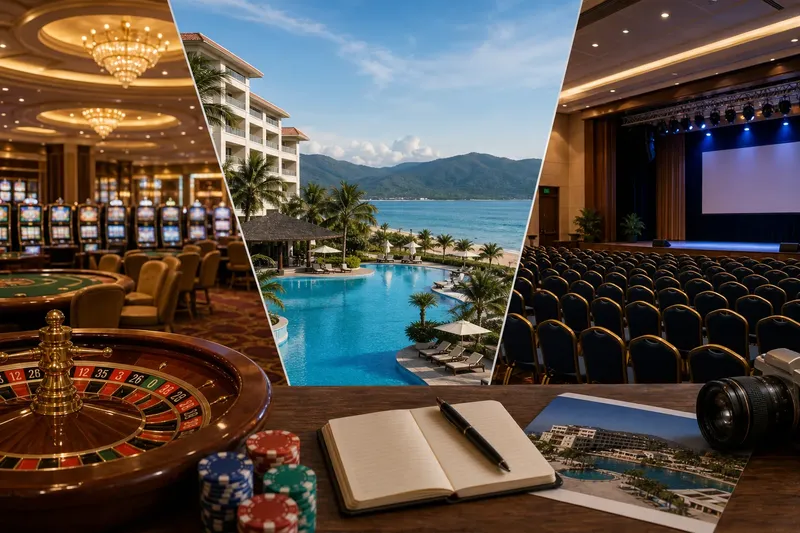
The most common mistake in writing about casino culture in Khánh Hòa is to treat a casino-themed image as evidence of a local casino institution. That shortcut blurs a useful historical distinction: a place can appear in entertainment or tourism language without establishing that residents used the word to describe a real venue. A grounded account begins with what local records actually say.
Khánh Hòa’s documented leisure history needs local evidence
Khánh Hòa’s coastal setting and Nha Trang’s development as a destination make leisure an important subject for local history. But that broad context cannot, by itself, establish when or how the word “casino” entered local public language. Nor does a reference to tourism prove that a casino operated in a particular place. Those claims require records tied to a date, location, and source.
Useful evidence might include local newspaper issues, tourism brochures, event programs, business directories, photographs with reliable captions, and archival documents. Each source answers a different question. A brochure can show how a destination was promoted; a directory may identify a business; an event program can document what organizers advertised. None should be treated as interchangeable.
For a historical account, the practical task is to record the wording and provenance of each item: who produced it, when, where it circulated, and what it explicitly names. If a source uses “casino” as a decorative or entertainment term, quote or describe that use precisely. If it names a venue, preserve the source’s exact claim and seek corroboration before expanding it.
Casino language can describe a venue, a game, or a mood
“Casino” does not do the same work in every text. It may name an institution, refer to gambling, describe a social setting, or serve as shorthand for glamour, suspense, or risk. The surrounding words help identify which meaning is intended: a street address and operating details point toward a place, while stylized imagery and dramatic language may signal a theme.
That distinction matters in Khánh Hòa’s public language. A tourism advertisement might borrow casino imagery to evoke excitement without describing local leisure practices. A film poster or performance notice might use the same vocabulary as a dramatic cue. These are evidence of how the idea was presented, not automatically evidence of a venue or its audience.
It is not worth the effort to force every casino reference into one continuous local history. A better account marks separate kinds of evidence and allows a gap to remain when the records do not connect them.
Public entertainment can circulate casino imagery without documenting a local institution
Printed material, performances, and screen entertainment can carry an image beyond the place or activity that first gave it meaning. In historical work, the important question is not whether a picture looks familiar, but what its maker intended and what the accompanying text says. A poster may reveal the mood an organizer wanted to sell; a news report may identify an event; a photograph may show a room without naming its purpose.
For Khánh Hòa, this approach keeps local history distinct from a generic account of casino imagery. A researcher can document an image’s appearance in a locally circulated source while remaining cautious about its origin and reception. Unless records identify local readers or viewers, claims about how residents understood it should remain questions rather than conclusions.
A source-by-source check keeps local claims proportionate
- Check the source’s date and place of publication. If both are clear and relevant to Khánh Hòa, use it as local evidence; if either is missing, describe it as undated or unlocated rather than assigning it a local origin.
- Check whether “casino” names a specific venue. If the text gives an identifiable place or operator, record that claim and seek another source; if it only uses the word as a theme, classify it as imagery or language instead.
- Check what the item directly depicts. If a caption identifies the scene and its setting, report that attribution; if the image is unlabeled, describe visible details without naming the venue.
- Check who produced the material and for what purpose. If it is promotional, use it to discuss intended presentation; if it is a news or administrative record, assess what its reporting or official purpose allows it to establish.
- Check whether a second source supports the same claim. If independent material agrees on the venue or event, present the connection with its evidence; if not, state that the identification remains uncertain.
- Check whether the source describes participation or only visibility. If it documents admission, attendance, or rules, discuss access within those limits; if it merely advertises or depicts an event, do not infer who attended.
A worked archival example shows how to limit a claim
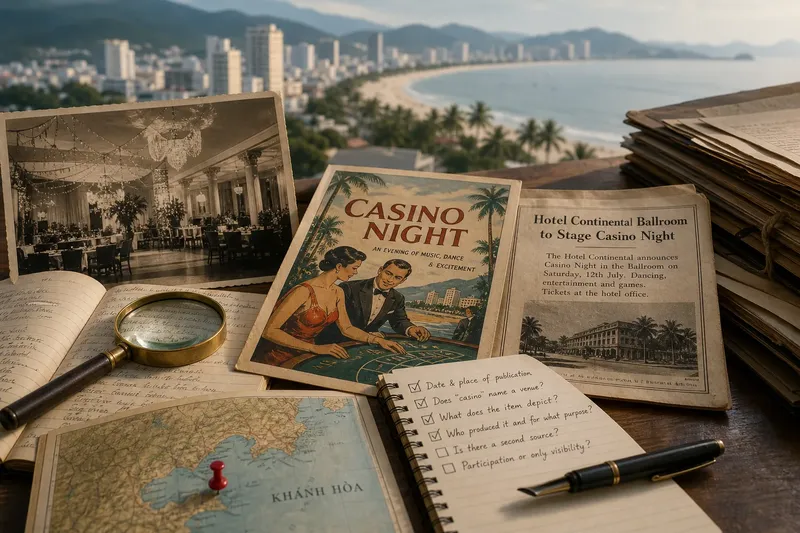
Say a researcher has three invented items in a Khánh Hòa collection: an undated photograph of a decorated hall, a dated tourism leaflet that uses the phrase “casino night” for an advertised event, and a later newspaper notice naming a hotel ballroom as the event location. These values and documents are invented for illustration, not claims about actual local sources.
The researcher first records the photograph’s visible features but does not call the hall a casino because its caption and date are missing. Next, the leaflet is entered as evidence that its publisher used casino language in promoting an event; it does not establish that gambling took place. Finally, the newspaper notice is compared with the leaflet: if its date, event wording, and named hotel align, the researcher can cautiously link the advertisement to that event, while still avoiding claims about activities or attendance the notice does not document. If they do not align, the items remain separate.
The resulting account is specific but restrained: a local source used casino language for an advertised event, while the photograph’s setting remains unidentified. That is more informative than turning three incomplete items into a story about an established venue.
What can readers infer from casino references in Khánh Hòa?
Does a casino-themed advertisement prove a casino operated locally?
No. It documents the language and presentation used by the advertiser, unless it also identifies a particular operating venue. A separate, appropriately dated source is needed to support the stronger claim.
Can an image establish what an event was?
Usually not on its own. Captions, accompanying text, provenance, and corroborating records help identify a scene; without them, describe what is visible and leave the event’s identity open.
How should a writer handle conflicting local sources?
Present the disagreement and identify what each source says rather than choosing the more vivid version. If the conflict cannot be resolved, state that the record remains uncertain.
What is a useful search for the history of casino culture in Khánh Hòa?
Search local newspapers, tourism materials, event notices, and archival catalogs using the exact terms found in each item, alongside place names such as Nha Trang. Keep results tied to their source and date, and distinguish documented local usage from general casino imagery.
Local history becomes clearer when claims stay close to records
A careful history of casino culture in Khánh Hòa need not begin with a grand origin story. It can trace concrete appearances of the word and image across local material, identify what each source establishes, and leave unsupported links unresolved. That method also separates a record of public language from a record of business, gambling, or participation.
For readers searching casino culture in Khánh Hòa, the most useful distinction is between a documented local reference and an interpretation built from it. A source can show that an image circulated or that an event was advertised; only evidence suited to the claim can establish what happened at a venue. Keeping that boundary visible makes even a small local archive more legible.