Casino, Resort, Venue: Three Words with Different Jobs
Casino, resort, and venue describe different things. Learn what each label tells you, what it leaves out, and how to choose precise language.
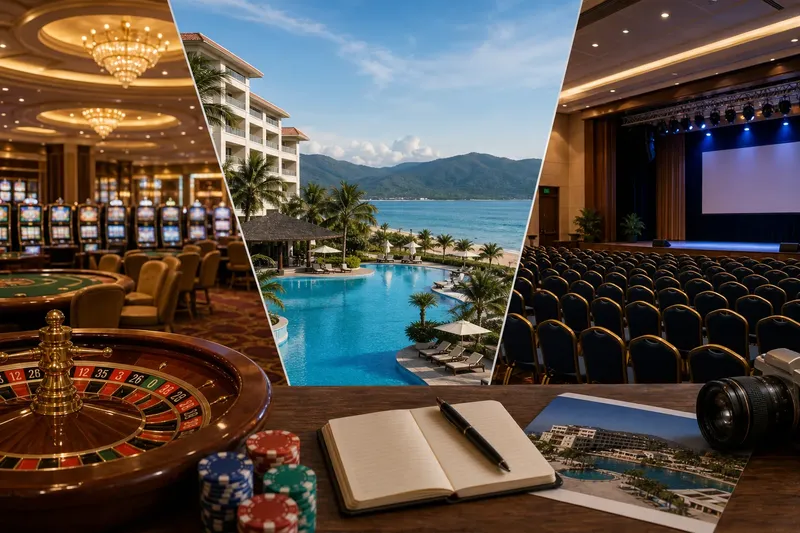
The most common mistake in a public description is treating “casino,” “resort,” and “venue” as interchangeable labels. That shortcut can make a reader misunderstand what a place offers, what kind of visit to expect, or which details still need checking. In Khánh Hòa, where leisure settings may be described for visitors with different expectations, choosing the right noun is a small but meaningful act of clarity.
Each word points to a different question. “Casino” names a particular kind of activity or institution. “Resort” frames a broader leisure setting. “Venue” identifies a place as a location for an event or activity without saying much about its character. None tells the whole story by itself, and the best choice depends on what the sentence needs to explain.
Casino names an activity, not a whole visit
When a description uses casino, it puts gaming at the center of the reader’s attention. The word may refer to a facility or to the casino element within a larger property. Either way, it prompts questions about what kind of gaming is involved, who may enter, and what rules apply.
That focus can be useful when gaming is the subject. A news caption about a casino-related event, for instance, should not blur the subject by calling it only a resort. But the word leaves many practical matters unanswered: it does not say whether the place also has lodging, restaurants, entertainment, or public event space. Nor does it establish who can access any particular area.
In Khánh Hòa, as elsewhere, readers may encounter casino language in promotional copy, travel conversation, local reporting, or descriptions of entertainment. The same label can carry different weight in each setting. An advertisement may use it to signal a theme or attraction; a report may use it to identify the subject precisely. A reader should look at the surrounding words rather than infer a full itinerary from the noun alone.
Resort frames a broader leisure setting
Resort generally describes a place presented as a destination for leisure, often with several services or activities grouped together. It gives a broader impression than casino: the emphasis is on a stay or visit, not on one particular activity. The word can help when a sentence concerns the overall setting, such as accommodation, dining, relaxation, or entertainment.
Its breadth is also its limitation. Calling somewhere a resort does not establish that it contains a casino, that every listed service is available to every visitor, or that the property is suited to a particular traveler. “Resort” is a useful frame, not a complete inventory. If a detail matters, name it separately and check the specific description.
For Khánh Hòa, resort language can fit a discussion of how visitors imagine a leisure destination or how a property presents itself. It is less precise if the point is specifically about gaming rules, a performance, or a particular public gathering. In those cases, the broad label may conceal the very activity the reader needs to understand.
Venue identifies a place for an event
Venue is the most neutral of the three terms. It tells the reader that a location is being used for an event or activity, such as a performance, gathering, or conference. It does not, by itself, claim that the location is a casino or a resort.
This neutrality makes “venue” useful when the event matters more than the property’s identity. A local listing might call a room or site a venue for an evening performance without implying anything about gaming or overnight stays. The word also avoids making an event sound more exclusive or more comprehensive than the available details support.
But “venue” can feel empty if it is the only description. Readers may still want to know whether the place is a theater, a hotel function room, an outdoor space, or part of a larger leisure property. Add the specific type of venue when it is known and relevant. If it is not known, keep the wording modest rather than filling the gap with assumptions.
Choose the word that answers the reader’s first question
A useful choice begins with the purpose of the sentence. Ask what the reader needs to recognize immediately: the activity, the overall leisure setting, or the event location. Use the label that answers that question, then add a more specific detail where the label alone falls short.
- Use “casino” when gaming is the topic or the defining feature being discussed. Add the relevant activity or access detail if it is known and necessary.
- Use “resort” when the sentence concerns a broader destination or leisure property. Name the particular service or feature rather than expecting the broad label to supply it.
- Use “venue” when the event location is the point. Identify the event or the type of space if readers need that context.
- Use a paired description when two functions matter equally, such as “a resort with a casino” or “a performance venue within a hotel.” This makes the relationship clearer than a string of labels.
- Stay neutral when details are uncertain. A plain reference to a place or event is better than assigning a category that the available information does not support.
Say a local arts listing describes an evening performance at a property that also offers lodging and gaming, but the listing is chiefly about the show. Calling the location “the performance venue” keeps the reader’s attention on where the event takes place. If the lodging is relevant to the surrounding description, “a resort with a performance space” adds that context; if gaming is central to the story, “casino” may be the more accurate lead. Each choice changes the reader’s first expectation, so the sentence should follow the subject rather than the most vivid label.
It is not worth stacking all three words into every description simply to sound comprehensive. A phrase such as “casino resort venue” may seem thorough, but without explaining how the terms relate, it can leave readers less certain than before. One well-chosen label and one clarifying detail usually do more.
Which label fits the description?
Does “resort” mean a casino is on the property?
No. Resort describes a broader leisure setting and does not, on its own, establish that gaming is offered. If the casino element matters, state it separately and rely on the property’s specific description for details.
Can “venue” describe a casino property?
Yes, when the sentence is about an event or activity hosted there. The word identifies the place in relation to that use; it does not explain the property’s other functions.
Which word should a travel description lead with?
Lead with the feature most relevant to the reader’s decision. Use “resort” for the broader stay, “casino” for gaming, or “venue” for an event location, then supply the specific information the label leaves open.
What if a public description uses the labels loosely?
Read the surrounding details and separate the stated facts from the impression created by the wording. If access, services, or event arrangements matter, consult the relevant official description rather than treating a broad label as confirmation.
Clear labels make leisure language easier to trust
These words do different jobs, even when they refer to parts of one property. “Casino” foregrounds gaming, “resort” frames a wider leisure destination, and “venue” locates an event. Choosing among them is not a matter of finding the grandest-sounding term; it is a matter of matching the noun to the reader’s question.
When a description concerns casino language in Khánh Hòa, that distinction helps keep local context visible without asking one word to explain everything. Use the most precise label the available information supports, and pair it with the detail that matters. That habit leaves fewer assumptions for readers to fill in themselves.